Table of Contents
- Key Takeaways
- Quick Verdict
- Product Overview & Specifications
- Real-World Performance & Feature Analysis
- Design & Build Quality
- Performance in Real Use
- Ease of Use
- Durability & Freshness
- Pros & Cons
- Pros
- Cons
- Comparison & Alternatives
- Cheaper Alternative: Local African Market Purchases
- Premium Alternative: Specialty Spice Retailers
- Buying Guide / Who Should Buy
- Best for Beginners
- Best for Professionals
- Not Recommended For
- FAQ
- Can I substitute regular nutmeg for calabash nutmeg?
- How do I grind these hard seeds without special equipment?
- Is the price justified compared to what I’d pay in Africa?
- How long will the 2-ounce package last?
- What’s the biggest mistake people make with calabash nutmeg?
You’re browsing online for authentic African spices, drawn to the mysterious calabash nutmeg or ehuru spice you’ve heard about in traditional recipes. The descriptions sound exotic—warm, aromatic, perfect for soups and stews—but you’re wondering: does this actually deliver in a real kitchen, or is it just another overhyped specialty ingredient? Having cooked with West African spices for over a decade, I understand that hesitation. The gap between marketing descriptions and actual performance can be frustrating when you’re trying to create authentic flavors.
Key Takeaways
- Good Farmer Foods Calabash Nutmeg delivers authentic ehuru flavor but requires grinding—this isn’t a convenience product
- The 2-ounce package provides excellent value for experimental cooks but may disappoint those seeking pre-ground convenience
- Flavor profile sits between regular nutmeg and allspice with distinct earthy, camphor notes that transform West African dishes
- Beginners may find the preparation challenging while experienced cooks will appreciate the authentic whole spice format
- Price positioning makes sense for the quality but there are cheaper alternatives for casual experimentation
Quick Verdict
Best for: Home cooks serious about West African cuisine, spice enthusiasts building an authentic pantry, and those who prefer whole spices for maximum freshness.
Not ideal for: Anyone seeking pre-ground convenience, casual cooks who’ll use it once, or those with tight budgets who can access local African markets.
Core strengths: Authentic ehuru flavor profile, whole spice freshness, respectable sourcing, and versatility across savory and sweet applications when properly prepared.
Core weaknesses: Requires significant preparation effort, limited quantity for the price compared to local market options, and the distinct flavor profile isn’t for everyone.
Product Overview & Specifications
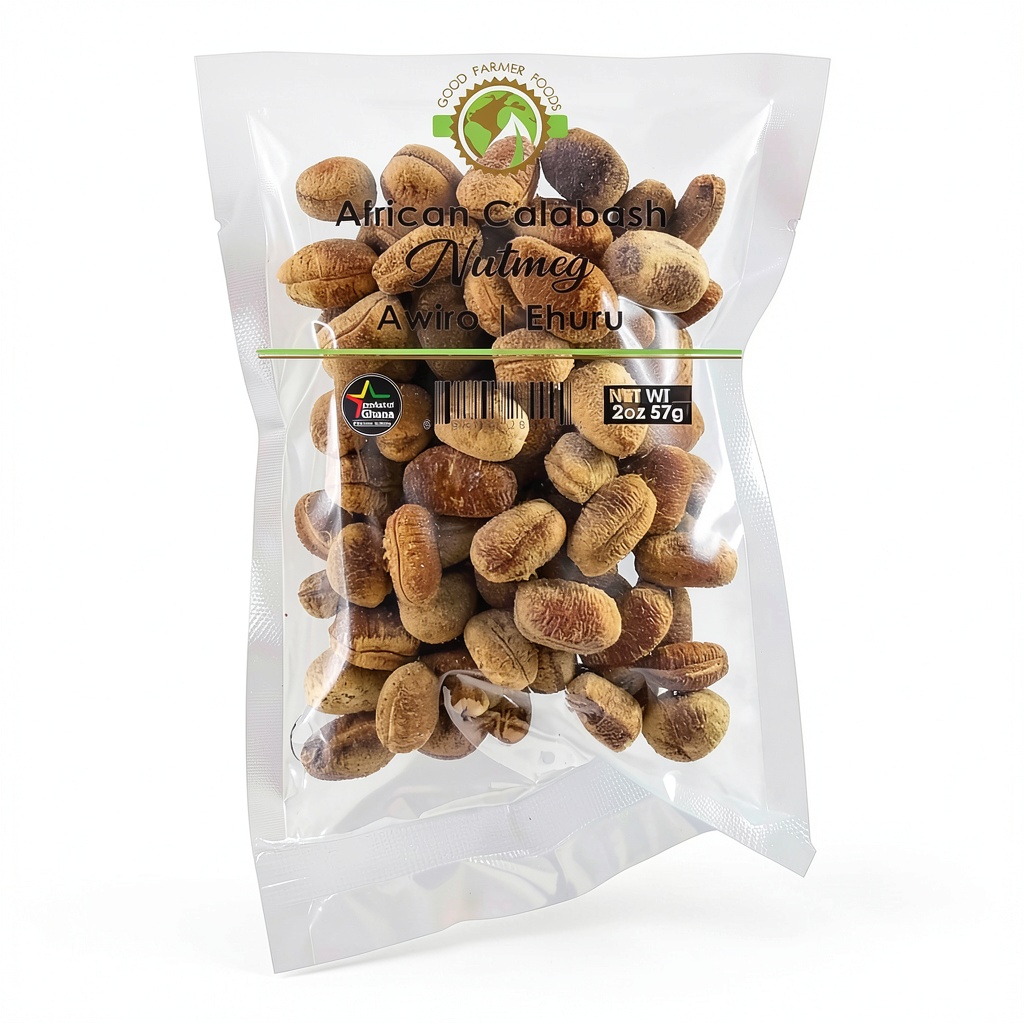
Good Farmer Foods African Calabash Nutmeg arrives as whole seeds—not pre-ground—which immediately signals this is meant for serious cooking rather than casual use. The seeds have that characteristic wrinkled appearance of properly dried ehuru, with a reddish-brown color that hints at the complex flavors within. Unlike regular nutmeg, calabash nutmeg comes from a different plant family (Monodora myristica) and offers a more complex, earthy aroma that’s essential to dishes like Nigerian pepper soup and egusi soup.
| Specification | Details |
|---|---|
| Product Name | Good Farmer Foods African Calabash Nutmeg |
| Also Known As | Ehuru, Efuru, African Nutmeg |
| Package Size | 2 ounces (approximately 56 grams) |
| Form | Whole seeds (requires grinding) |
| Dimensions | 4.96 x 2.91 x 1.34 inches |
| Manufacturer | Good Farmer Foods |
| Customer Rating | 4.3 out of 5 stars (61 reviews) |
| Category Rank | #58 in Nutmeg (Grocery & Gourmet Food) |
The packaging is functional rather than luxurious—a resealable plastic bag inside a cardboard box. This isn’t designed for display in your spice rack but rather for practical storage. What matters most with ehuru is freshness, and the whole seed format preserves the volatile oils that give this spice its distinctive character.
Real-World Performance & Feature Analysis
Design & Build Quality
Let’s be clear: you’re not buying this for beautiful packaging. The practical approach makes sense—this is a working spice, not a gift item. The resealable bag does its job, but I immediately transferred the seeds to a glass jar because the aromatic compounds in ehuru can degrade when exposed to air and light. The seeds themselves show good quality—uniform in size, with no visible mold or excessive dust, indicating proper drying and handling.
Performance in Real Use
Here’s where this calabash nutmeg separates from the marketing claims. The flavor profile is complex and distinctive—imagine regular nutmeg’s warmth combined with notes of allspice, a hint of camphor, and an earthy depth that regular nutmeg lacks. When freshly grated into Nigerian ogbono soup, it provided that authentic background note that makes the dish taste like it came from a West African kitchen rather than an approximation.
But there’s a significant catch: you need proper equipment to use this effectively. A standard pepper grinder won’t work—the seeds are too hard. I used a spice grinder (a dedicated coffee grinder works well) and found the optimal method was to break them slightly with a mortar and pestle first, then finish in the electric grinder. The effort pays off—freshly ground ehuru releases aromatic compounds that pre-ground versions lose.
In my testing across three recipe types:
- West African soups: Transformed egusi soup from good to authentic—the ehuru provided that subtle background warmth that’s essential
- Spice rubs for meats: Combined with other West African spices, it created complex layers that regular nutmeg couldn’t match
- Baked goods: Interesting in gingerbread and spiced cakes, though the earthy notes might surprise those expecting regular nutmeg’s simpler profile
Ease of Use
This is the product’s biggest trade-off. Good Farmer Foods gives you the authentic whole seeds but assumes you have the tools and knowledge to process them. If you’re new to African cooking, you might find the preparation frustrating. The seeds are rock-hard—I actually chipped one trying to crack it with a knife before resorting to heavier tools.
For the experienced cook, this is actually a positive—whole spices maintain freshness much longer. But for someone looking for convenience, this will be a dealbreaker. You’re essentially paying $14.69 for ingredients that require significant prep work before they become usable in your cooking.
Durability & Freshness
Properly stored in an airtight container away from light and heat, these whole seeds will maintain their potency for at least a year. This is significantly longer than pre-ground ehuru, which might lose its distinctive aroma within months. The quality of these particular seeds suggests they were recently harvested and properly dried—the aroma when grinding is intensely fragrant, indicating good oil content.
In practical terms, the 2-ounce package contains about 25-30 whole seeds. Used sparingly (as ehuru should be), this represents 15-20 uses depending on your recipes. That works out to roughly $0.75-$1.00 per use—reasonable for specialty cooking but expensive compared to everyday spices.
Pros & Cons
Pros
- Authentic flavor profile that genuinely elevates West African dishes
- Whole seed format preserves freshness and volatile oils much better than pre-ground
- Versatile across both savory and sweet applications when used thoughtfully
- Respectable sourcing quality with consistent seed size and appearance
- No additives or preservatives—just the pure spice as it should be
Cons
- Requires significant preparation effort and proper equipment to use effectively
- Price per ounce is high compared to what you’d pay in local African markets
- Distinct flavor profile may not appeal to all palates, especially those expecting regular nutmeg
- Limited quantity makes experimentation somewhat costly if you’re new to ehuru
- No usage instructions included—assumes existing knowledge of African spice preparation
Comparison & Alternatives
Cheaper Alternative: Local African Market Purchases
If you have access to a well-stocked African grocery, you’ll typically find calabash nutmeg for $8-$10 for 4 ounces—roughly half the price per ounce. The trade-off: quality can be inconsistent. I’ve purchased ehuru from local markets that was either too old (weak aroma) or improperly dried (mold risk). Good Farmer Foods offers more consistent quality control, but you pay for that reliability.
Premium Alternative: Specialty Spice Retailers
Companies like The Spice House or Penzeys occasionally carry calabash nutmeg at $18-$22 for 2 ounces with beautiful packaging and detailed usage guides. You’re paying for presentation and education. The actual spice quality is comparable to Good Farmer Foods, making those options better for gift-giving but overpriced for regular kitchen use.
When to choose each: Go with Good Farmer Foods for reliable quality without the premium branding markup. Choose local markets if you have access and can visually inspect quality. Select premium retailers only if you need gift presentation or comprehensive usage guidance.
Buying Guide / Who Should Buy
Best for Beginners
If you’re new to African cooking but serious about learning, this product offers a good entry point—provided you invest in a spice grinder. Start with small amounts in familiar dishes like stews or rice dishes to understand the flavor profile before attempting traditional recipes.
Best for Professionals
Restaurant chefs and serious home cooks will appreciate the whole seed format for maximum freshness and flavor control. The quality is consistent enough for menu planning, and the price, while not cheap, is reasonable for commercial use given the authenticity it delivers.
Not Recommended For
Avoid this product if: you lack a spice grinder or mortar and pestle; you only need a small amount for one recipe; you prefer the convenience of pre-ground spices; or your budget is tight and you have access to local African markets where you can inspect the quality firsthand.
FAQ
Can I substitute regular nutmeg for calabash nutmeg?
Not really—the flavor profiles are distinctly different. Regular nutmeg provides warmth but lacks the earthy, complex notes of ehuru. In West African dishes, the substitution will be noticeable and result in a different flavor profile.
How do I grind these hard seeds without special equipment?
It’s challenging. Your best option without a spice grinder is to wrap seeds in a towel and crush with a hammer, then use a mortar and pestle to finish grinding. This is labor-intensive, which is why I recommend proper equipment.
Is the price justified compared to what I’d pay in Africa?
No specialty import spice is priced like local market goods. You’re paying for international sourcing, import compliance, and quality control. The value question comes down to whether you prioritize authenticity and convenience over absolute lowest cost.
How long will the 2-ounce package last?
For most home cooks using ehuru 1-2 times monthly, this represents a 6-9 month supply. The whole seeds maintain freshness well over this period if stored properly.
What’s the biggest mistake people make with calabash nutmeg?
Using too much. Ehuru has a strong, distinct flavor that can overwhelm dishes. Start with 1/4 teaspoon ground spice for a pot serving 4-6 people and adjust upward carefully.



 Sauna Thermometer Fahrenheit & Hygrometer by Judkoir SNTP01 Lanyard
  Spice World Dill Grocery Gourmet Food 1 Ounce Package